
Deeper understanding leads to better outcomes
12 Feb 2026
SMBC Americas CEO Appears on Bloomberg to Discuss U.S. Expansion
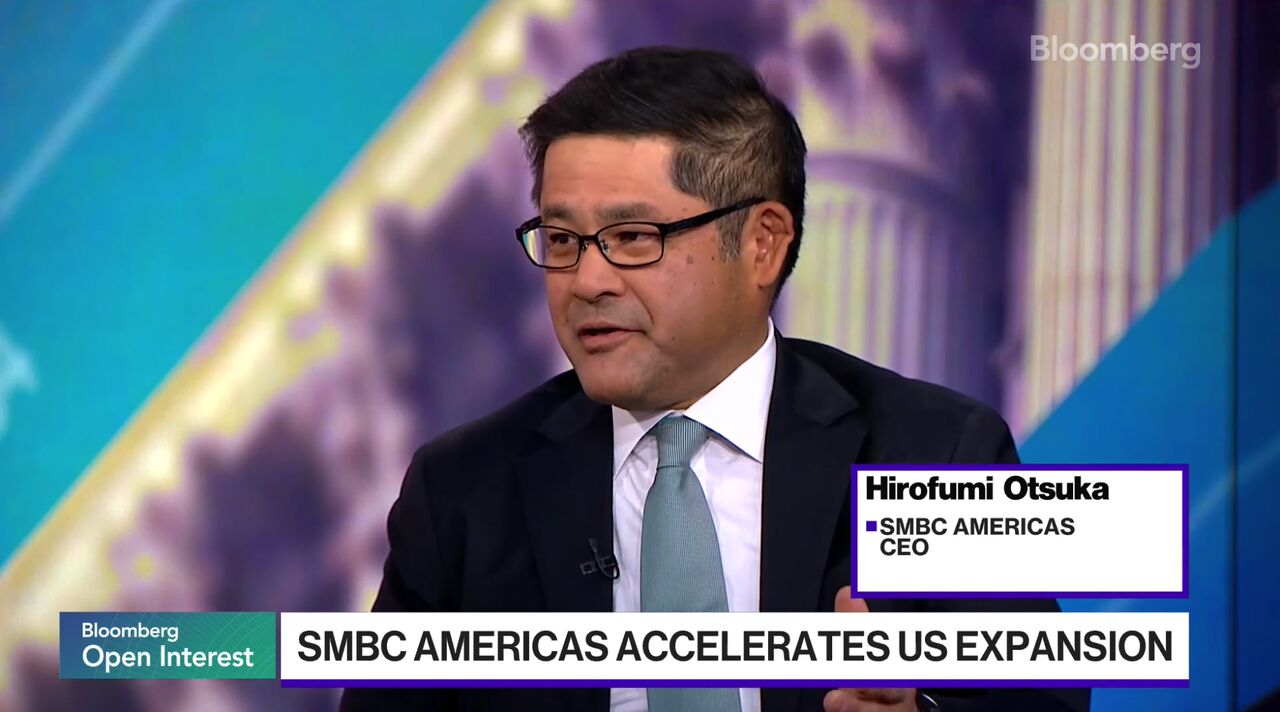
SMBC Group Americas CEO Hirofumi Otsuka joined Bloomberg Open Interest with Dani Burger and Matthew Miller to discuss the bank’s continued growth across the U.S., as well as the unique advantages its Japanese roots offer clients across both markets.
He highlighted three key growth areas driving SMBC’s strategy: AI and digital infrastructure, private credit, and cross border M&A. Otsuka-san noted rising demand tied to data centers, energy, and related infrastructure, as well as strong interest from Japanese companies investing in the U.S. Watch the interview via Bloomberg's website.
Full Transcript:
Matt: To continue the conversation, we are joined by the CEO of SMBC. The bank is in the middle of a push to expand its presence in the U.S. Thank you for joining us. I have to say, we will get into the AI bit in a bit, but there's a narrative of the U.S. maybe being a less attractive place to be for foreign entities. The growth is abroad. It's a mature market here. Geopolitics adds to it. Why make this push in the U.S. now?
Hirofumi: First of all, it’s not really why now for us. We have been operating in the market for over 100 years. So, it’s not new for us. But at the same time, we see more and more ties between the U.S. and the Japanese market, and it brings a lot of opportunities for us, Japanese banks.
Matt: Where are the biggest opportunities? I’m thinking everyday about obviously AI, data centers, this huge push. We don't really have the infrastructure, we don't really have the gear, and we need to buy it all and bring it on. I mean, Google’s announcement that they’re going to spend $185 billion this year sort of highlights that.
Hirofumi: Of course. The primary business of SMBC is to help corporate clients and perhaps active global sponsors operate and grow where they want to go. We are very focused on helping them in three core areas. One is AI. The other is private credit, and the last is M&A. All three things are naturally advantageous for Japanese banks. AI, if you look at the Japanese market, there is a demographic challenge. The Japanese government has been hugely pushing to support AI to improve and enhance productivity. Naturally, Japanese banks are in the middle of that shift. Private credit—there is strong demand for asset-backed financing. We have a global sponsor financing team and a structured finance team that supports that. SMBC is a global player, and the customers operate globally. Lastly, M&A is a huge area of opportunity for us given that there is strong business ties between the U.S. and Japan and tremendous interest by the Japanese companies investing in the U.S. market.
Dani: Can you give a sense of the different categories on just how big AI is as part of that? Is that where the biggest growth is? Is that the biggest part of the offering? Or Is it still early innings?
Hirofumi: I think it is still early innings, but there is more demand and more growth in that sector. It is not only data centers. There is a lot of business surrounding the data centers’ infrastructure that is to be built, whether it is energy, cables, whether it is cooling systems. All these industries are supported by Japanese companies that would like to hugely invest in the U.S. market.
Matt: I key onto the last part of your triumvirate, which is the M&A push. Because you say Japanese companies are so interested in investing in the U.S. There is not really a "sell America" trade that you see as evident in terms of mergers and acquisitions. Regardless of our huge national debt—which, I know, the Japanese have an even bigger national debt to GDP—regardless of our concerns about an independent Fed, regardless of what is happening about Greenland or Minneapolis, you are saying Japanese companies want to invest here?
Hirofumi: Yes. Let’s not forget the Japanese government was one of the first governments to agree with the U.S. government on the tariff agreements. They have committed to making a huge investment into the U.S. market. It's not so much about the commitment itself. It is a proof of confidence. It is a proof of security that you can freely invest in the U.S. market for Japanese companies. When you look at the Japanese market, it is a maturing market that you need to find areas of growth. There is tremendous opportunity and interest for Japanese businesses to invest in the U.S.
Dani: Can I ask about investment going the other way? It feels like every couple of weeks there is a private capital firm that is saying, "We are going into Japan," whether it is KKR, Blackstone, whoever, they’re like “this is the big market opportunity.” The stereotype of Japanese companies used to be that they would not sell to private capital, especially American buyers. Has something changed?
Hirofumi: Yes. I would say that corporate governance has improved significantly in Japan. The Japanese government, the business leaders, and the corporate space are very open to change and reform. You are actually seeing that a lot in the Japanese market. Therefore, business leaders are very open for change and transformation. You see a lot of activities in the corporate sector, whether it is privatization, spin-offs, mergers, acquisitions. Again, going back to a bank like SMBC, we can be valuable providing services to help when businesses transform. We are very excited about the Japanese market, and we can always be valuable to U.S. customers that are interested in coming into the Japanese market.
Matt: SMBC has been in business in America for over 100 years. You have been there for a long time as well. There has been a couple of times in American history when immigration was tough. Right now is one of those times. How does that play out in terms of getting your employees in and out of the country, in terms of getting visas to work for people who are not American citizens? Those must be important to you as a business.
Hirofumi: Of course. The key to success in business is that you adhere to the local practices. When you look at SMBC's office in New York, it is mostly localized. We do have expats coming from Japan, and vice versa, we do do have Americans working in our Tokyo office as well. There is an element of that. But overall, what is important is that we have people that are capable of supporting the business.
Dani: I would love to just finally get your thoughts on the competitive landscape. There are many banks—big U.S. behemoths—who have really, really strong AI infrastructure in parts of the new economy and are making a push forward. How competitive is it to announce some of these things?
Hirofumi: Again, we are not a U.S. bank. We are a Japanese bank, and that is what differentiates us compared to our competitors. We are in the middle of transformation in AI, given that we are a major bank, one of the largest banks in Japan, we are right in the middle of that transformation. We are a bank that has a huge franchise in both markets, U.S. and Japan. That gives us an advantage over competitors given there are many cross-border activities and M&A. I would say the fact we are in Japan and the fact that U.S.-Japan is a close ally gives us a huge advantage over competitors that play a meaningful role.
Dani: Thank you so much for joining us. This was an absolute pleasure.
He highlighted three key growth areas driving SMBC’s strategy: AI and digital infrastructure, private credit, and cross border M&A. Otsuka-san noted rising demand tied to data centers, energy, and related infrastructure, as well as strong interest from Japanese companies investing in the U.S. Watch the interview via Bloomberg's website.
Full Transcript:
Matt: To continue the conversation, we are joined by the CEO of SMBC. The bank is in the middle of a push to expand its presence in the U.S. Thank you for joining us. I have to say, we will get into the AI bit in a bit, but there's a narrative of the U.S. maybe being a less attractive place to be for foreign entities. The growth is abroad. It's a mature market here. Geopolitics adds to it. Why make this push in the U.S. now?
Hirofumi: First of all, it’s not really why now for us. We have been operating in the market for over 100 years. So, it’s not new for us. But at the same time, we see more and more ties between the U.S. and the Japanese market, and it brings a lot of opportunities for us, Japanese banks.
Matt: Where are the biggest opportunities? I’m thinking everyday about obviously AI, data centers, this huge push. We don't really have the infrastructure, we don't really have the gear, and we need to buy it all and bring it on. I mean, Google’s announcement that they’re going to spend $185 billion this year sort of highlights that.
Hirofumi: Of course. The primary business of SMBC is to help corporate clients and perhaps active global sponsors operate and grow where they want to go. We are very focused on helping them in three core areas. One is AI. The other is private credit, and the last is M&A. All three things are naturally advantageous for Japanese banks. AI, if you look at the Japanese market, there is a demographic challenge. The Japanese government has been hugely pushing to support AI to improve and enhance productivity. Naturally, Japanese banks are in the middle of that shift. Private credit—there is strong demand for asset-backed financing. We have a global sponsor financing team and a structured finance team that supports that. SMBC is a global player, and the customers operate globally. Lastly, M&A is a huge area of opportunity for us given that there is strong business ties between the U.S. and Japan and tremendous interest by the Japanese companies investing in the U.S. market.
Dani: Can you give a sense of the different categories on just how big AI is as part of that? Is that where the biggest growth is? Is that the biggest part of the offering? Or Is it still early innings?
Hirofumi: I think it is still early innings, but there is more demand and more growth in that sector. It is not only data centers. There is a lot of business surrounding the data centers’ infrastructure that is to be built, whether it is energy, cables, whether it is cooling systems. All these industries are supported by Japanese companies that would like to hugely invest in the U.S. market.
Matt: I key onto the last part of your triumvirate, which is the M&A push. Because you say Japanese companies are so interested in investing in the U.S. There is not really a "sell America" trade that you see as evident in terms of mergers and acquisitions. Regardless of our huge national debt—which, I know, the Japanese have an even bigger national debt to GDP—regardless of our concerns about an independent Fed, regardless of what is happening about Greenland or Minneapolis, you are saying Japanese companies want to invest here?
Hirofumi: Yes. Let’s not forget the Japanese government was one of the first governments to agree with the U.S. government on the tariff agreements. They have committed to making a huge investment into the U.S. market. It's not so much about the commitment itself. It is a proof of confidence. It is a proof of security that you can freely invest in the U.S. market for Japanese companies. When you look at the Japanese market, it is a maturing market that you need to find areas of growth. There is tremendous opportunity and interest for Japanese businesses to invest in the U.S.
Dani: Can I ask about investment going the other way? It feels like every couple of weeks there is a private capital firm that is saying, "We are going into Japan," whether it is KKR, Blackstone, whoever, they’re like “this is the big market opportunity.” The stereotype of Japanese companies used to be that they would not sell to private capital, especially American buyers. Has something changed?
Hirofumi: Yes. I would say that corporate governance has improved significantly in Japan. The Japanese government, the business leaders, and the corporate space are very open to change and reform. You are actually seeing that a lot in the Japanese market. Therefore, business leaders are very open for change and transformation. You see a lot of activities in the corporate sector, whether it is privatization, spin-offs, mergers, acquisitions. Again, going back to a bank like SMBC, we can be valuable providing services to help when businesses transform. We are very excited about the Japanese market, and we can always be valuable to U.S. customers that are interested in coming into the Japanese market.
Matt: SMBC has been in business in America for over 100 years. You have been there for a long time as well. There has been a couple of times in American history when immigration was tough. Right now is one of those times. How does that play out in terms of getting your employees in and out of the country, in terms of getting visas to work for people who are not American citizens? Those must be important to you as a business.
Hirofumi: Of course. The key to success in business is that you adhere to the local practices. When you look at SMBC's office in New York, it is mostly localized. We do have expats coming from Japan, and vice versa, we do do have Americans working in our Tokyo office as well. There is an element of that. But overall, what is important is that we have people that are capable of supporting the business.
Dani: I would love to just finally get your thoughts on the competitive landscape. There are many banks—big U.S. behemoths—who have really, really strong AI infrastructure in parts of the new economy and are making a push forward. How competitive is it to announce some of these things?
Hirofumi: Again, we are not a U.S. bank. We are a Japanese bank, and that is what differentiates us compared to our competitors. We are in the middle of transformation in AI, given that we are a major bank, one of the largest banks in Japan, we are right in the middle of that transformation. We are a bank that has a huge franchise in both markets, U.S. and Japan. That gives us an advantage over competitors given there are many cross-border activities and M&A. I would say the fact we are in Japan and the fact that U.S.-Japan is a close ally gives us a huge advantage over competitors that play a meaningful role.
Dani: Thank you so much for joining us. This was an absolute pleasure.